
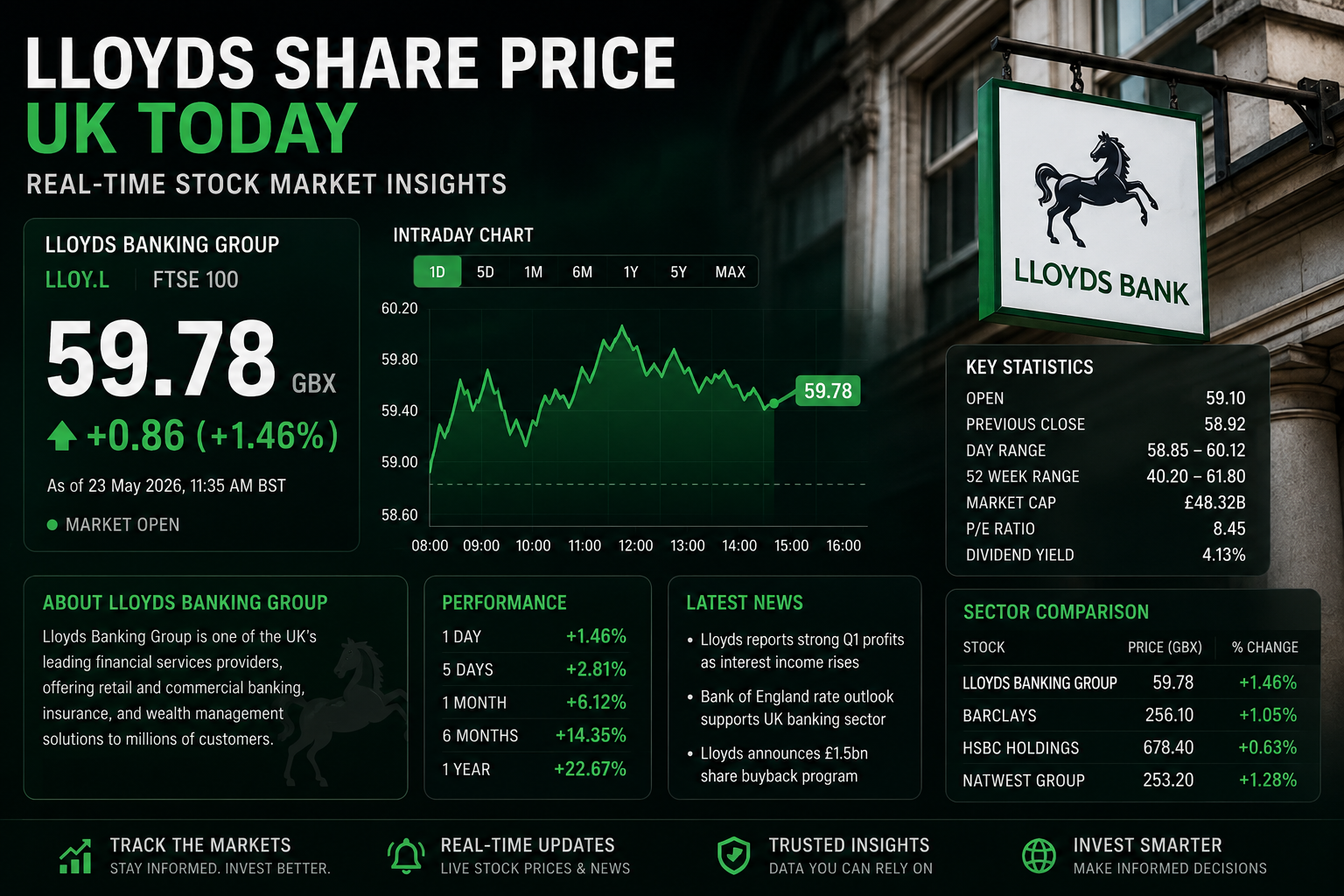

Introduction to Lloyds Share Price
The Lloyds share price is one of the most widely followed indicators in the UK stock market, reflecting investor confidence in the performance of one of Britain’s largest retail banking institutions, Lloyds Banking Group. As a major component of the FTSE 100 index, Lloyds Banking Group plays a significant role in shaping market sentiment across the UK financial sector.
In 2026, the Lloyds share price continues to attract strong attention from both retail and institutional investors. This is mainly due to ongoing economic changes, interest rate movements, inflation trends, and overall banking sector performance. Investors track the stock closely because even small movements in Lloyds shares can reflect broader shifts in the UK economy.
Understanding how the Lloyds share price behaves requires looking at both internal factors, such as financial results and dividend policy, and external influences like government regulations and global economic conditions.
Overview of Lloyds Banking Group
Lloyds Banking Group is one of the most important financial institutions in the United Kingdom, providing a wide range of services including personal banking, commercial banking, mortgages, savings accounts, and insurance products. The company owns several well-known brands, including Lloyds Bank, Halifax, and Bank of Scotland.
Because of its strong presence in the UK retail banking sector, the Lloyds share price is often seen as a reflection of the domestic UK economy. When consumer confidence is strong and borrowing activity increases, Lloyds typically performs well. On the other hand, economic downturns or rising loan defaults can put pressure on its stock performance.
The bank’s business model is heavily focused on the UK market, making it more sensitive to domestic economic conditions compared to globally diversified banks.
Factors Affecting Lloyds Share Price
The Lloyds share price is influenced by several key factors that investors closely monitor. One of the most important is interest rates set by the Bank of England. Higher interest rates often benefit banks because they increase the difference between lending and deposit rates, improving profit margins.
Another major factor is economic growth in the UK. When the economy is growing, consumers and businesses are more likely to borrow money, take mortgages, and use banking services, all of which support Lloyds’ revenue.
Inflation also plays a role, as it can affect consumer spending power and loan repayment ability. Additionally, regulatory changes, government policies, and housing market performance significantly influence investor sentiment toward Lloyds shares.
Historical Performance of Lloyds Share Price
The historical performance of the Lloyds share price has been shaped by major economic events, including the 2008 financial crisis, Brexit uncertainty, and the COVID-19 pandemic. During the financial crisis, the stock experienced a significant decline due to exposure to bad debts and banking sector instability.
In the years that followed, Lloyds underwent restructuring, improved its balance sheet, and reduced risk exposure, which helped stabilize its share price over time. However, recovery has been gradual, with periods of volatility influenced by macroeconomic uncertainty.
Long-term investors often study historical charts to identify patterns in Lloyds share price behavior, especially during periods of rising interest rates or economic recovery phases.
Recent Trends in Lloyds Share Price Movement
In recent years, the Lloyds share price has been closely linked to interest rate changes in the UK. When rates increase, banking stocks like Lloyds often experience upward momentum due to improved lending margins. However, short-term volatility remains common due to changing investor expectations.
Market sentiment has also been influenced by inflation trends, housing market activity, and consumer lending demand. Because Lloyds has strong exposure to UK mortgages, any changes in the property market can have a noticeable impact on its financial performance.
Additionally, global economic uncertainty and geopolitical events can sometimes create temporary fluctuations in the stock price, even though Lloyds is primarily a domestic-focused bank.
Dividend Policy and Investor Appeal
One of the key reasons investors follow the Lloyds share price closely is the company’s dividend policy. Lloyds Banking Group has historically aimed to return value to shareholders through dividend payments, making it attractive to income-focused investors.
Dividends are usually influenced by profitability, regulatory capital requirements, and overall financial stability. When Lloyds reports strong earnings, it may increase or maintain dividend payouts, which often supports positive movement in the share price.
For long-term investors, dividends play an important role in total returns, not just the share price itself.
Risks and Challenges Impacting Lloyds Share Price
Like all banking stocks, the Lloyds share price is exposed to certain risks. One of the main risks is economic downturns, which can lead to higher loan defaults and reduced lending activity. Since Lloyds is heavily focused on UK retail banking, it is particularly sensitive to domestic economic cycles.
Another challenge is regulatory pressure. Banks are required to maintain strict capital reserves and comply with financial regulations, which can limit profitability in some cases.
Competition from digital banks and fintech companies is also increasing, forcing traditional banks like Lloyds to adapt quickly to technological changes and evolving customer expectations.
Market Sentiment and Trading Activity
Investor sentiment plays a major role in short-term movements of the Lloyds share price. Even when financial performance remains stable, market psychology can drive volatility. Positive news such as strong earnings reports or improved economic forecasts can push the stock higher.
On the other hand, uncertainty around interest rates or economic forecasts can lead to selling pressure. Large institutional investors, hedge funds, and retail traders all contribute to daily price fluctuations.
Because Lloyds is part of the FTSE 100 index, its share price is also influenced by broader market movements across the UK stock market.
Future Outlook for Lloyds Share Price
The future outlook for the Lloyds share price depends on several key factors, including interest rate trends, UK economic growth, and the bank’s ability to adapt to digital transformation. Analysts generally believe that stable or rising interest rates could support earnings growth for Lloyds in the medium term.
The bank’s focus on cost efficiency, digital banking services, and customer experience improvements may also support long-term performance. However, external risks such as economic slowdown or housing market weakness could still create volatility.
Sustainability and ESG factors are also becoming increasingly important for investors, and Lloyds has been working to align its strategy with environmental and social governance expectations.
Conclusion on Lloyds Share Price
The Lloyds share price remains a key indicator of both banking sector performance and broader UK economic health. As part of Lloyds Banking Group, the stock reflects how consumer confidence, interest rates, and financial conditions are evolving in real time.
While short-term volatility is normal, long-term investors continue to monitor Lloyds due to its strong market position and dividend potential. Understanding the factors that influence its share price helps investors make more informed decisions in a constantly changing financial environment.